
Moose Hunting and the Weight of Hope
It’s midnight and I’m driving over Cameron Pass with my dad in the passenger seat. Moose archery season opens in five hours.
This is the moment my dad has been waiting for since he first started applying for a moose license more than twenty years ago. This is the moment he’s anticipated since getting an email in May that made him pump his fist with joy. This is the moment all the hours of scouting have led to.
It’s a heavy burden: the expectation, the excitement, the hope.
As my car winds down dark roads toward North Park, a light in the darkness of a vast reception-less stretch of Rockies, we talk about all our hopes. For a good hunt. For lots of action. For a big moose.
It stretches through three weekends and countless moose.
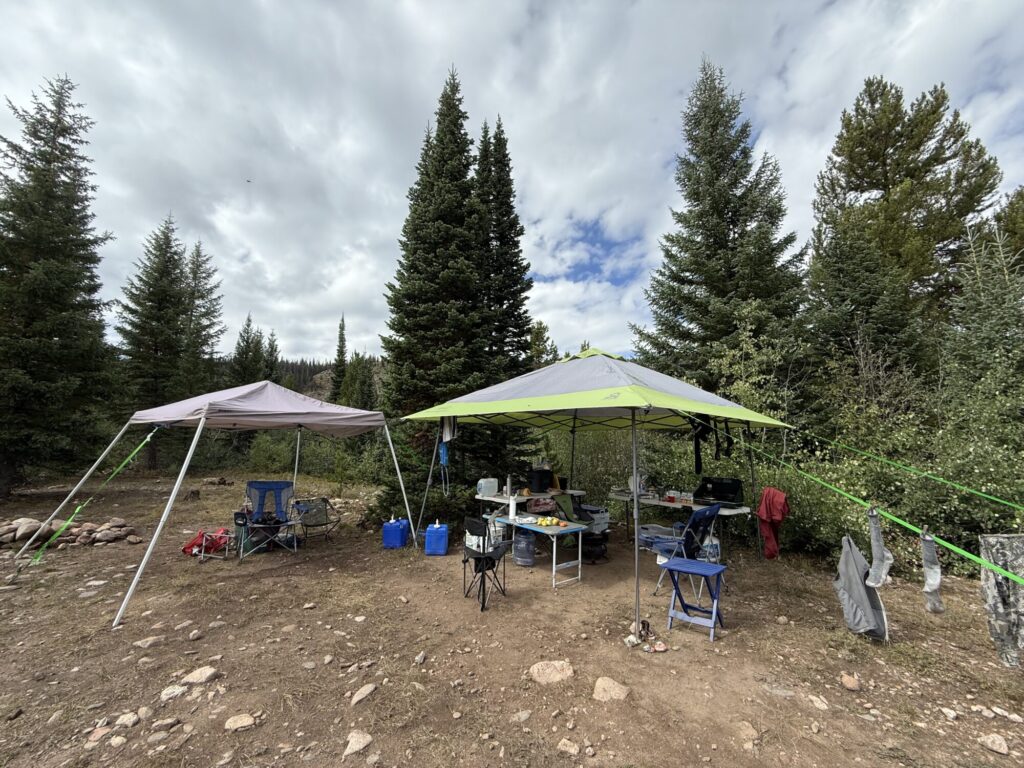
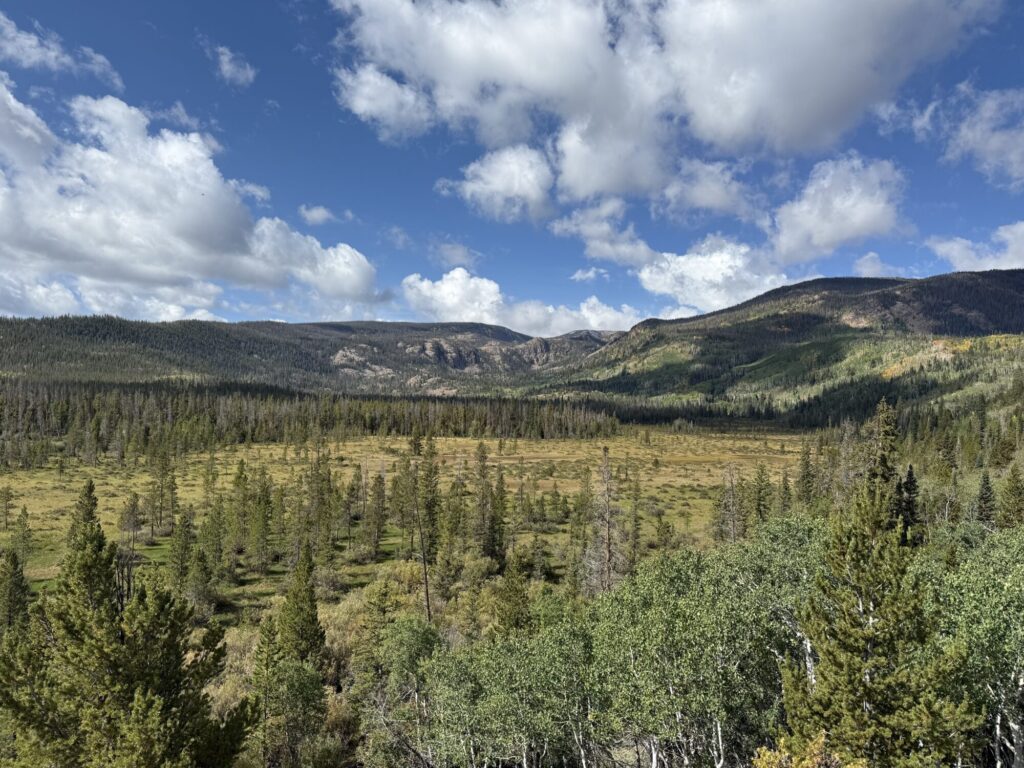
I remember it all. I remember following my dad and brother through a marsh of willows and my dad saying, “We’ll see them at the same time they see us. Willows won’t stop a charging moose, so make sure you have a plan.” I remember thinking: What plan? There are no trees to hide behind!
I remember seeing a cow moose browsing in a meadow and hearing the squelch each time she lifted her feet from the knee-deep mud.
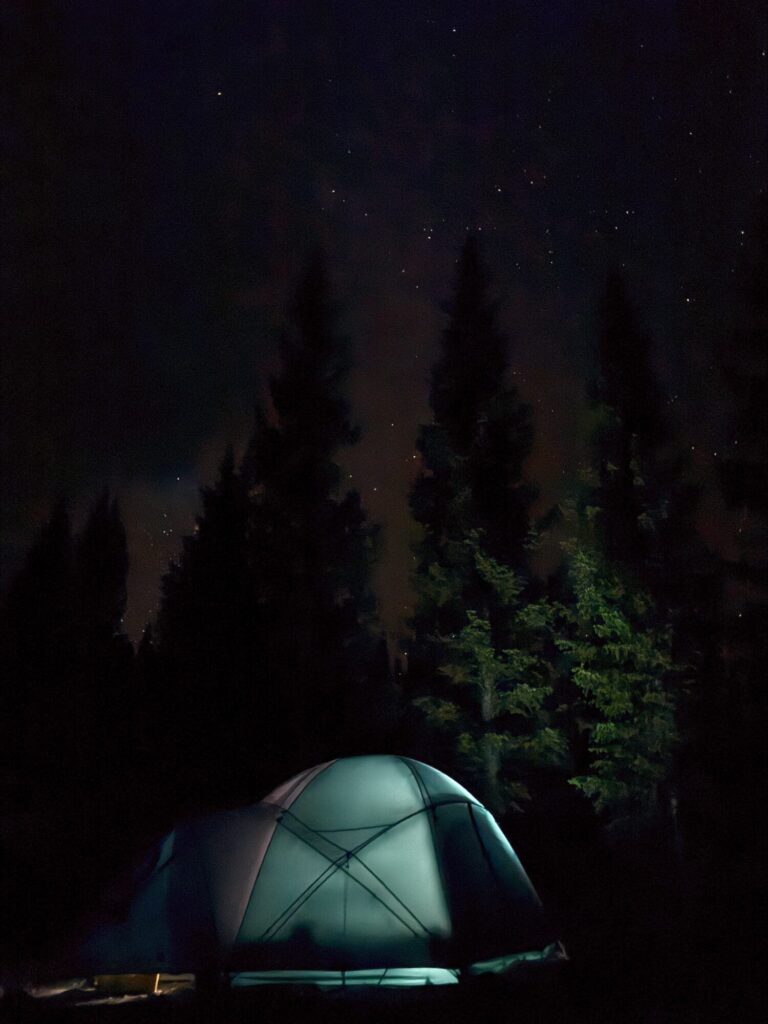
I remember sunlight thawing my frozen toes. I remember consuming cartoons of dehydrated Costco hashbrowns and tubs of pears from our tree at home. Nights of too little sleep and too early wakeups. Mornings where the Big Dipper cuts through sharp, cold air.
I remember when my Uncle Mike told me how to call in a moose with an empty whiskey bottle glued to a stick. And, when I tried the first time, how my dad said, “Your moose must have a tired neck.” Apparently, I am more dedicated than your average moose.
I remember miscommunications and tears and smiles and laughter. Black Velvet. Moose Rodeo. Hail and wind and rain in torrents. Tangled emotions and frustrated silence. A hunt like no other, bursting with hope and pressure and expectations to shoot a big moose.
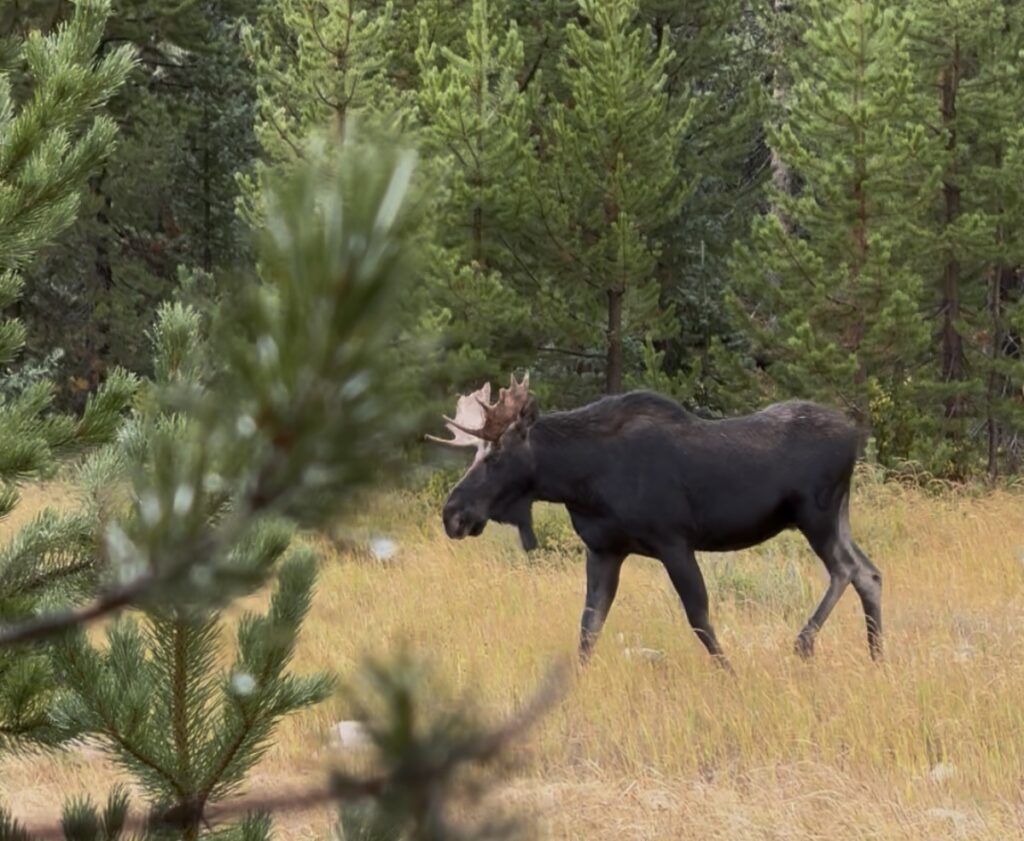
There’s a tangle of feelings inside us all. My dad is a good hunter. He wants to feed his family. He wants to sustainably harvest meat. He wants to spend time in the woods. He wants to carry on traditions. He wants to hunt because it is hard. He wants to hunt because it feels right. Walking through the woods with friends and family with a goal that not only will bring us intense joy, connect us to the natural world, and feed the family for an entire year, but is also a spiritual experience is one of the most amazing, unique feelings I have ever experienced. Hunting is an exercise in hope.
I remember Dad saying on the third weekend, “I didn’t think it would be this hard.”
We walk into the woods with a prayer, and most often we return with empty packs and full hearts. If hunting were easy, it wouldn’t fill my soul.
I remember driving up to camp one weekend and spotting a huge bull moose on private land. The sun is long since set, and he is only a dark blob with smudges of massive antlers strutting parallel to the road more than a hundred yards out, but I roll down the window, and I hear him grunt with every step. I realize I’m grinning. Alone, in my car, on the side of a dirt road in North Park, I am smiling to myself. The air is cold, but nothing like the weekend before, and I feel like the luckiest person on earth.
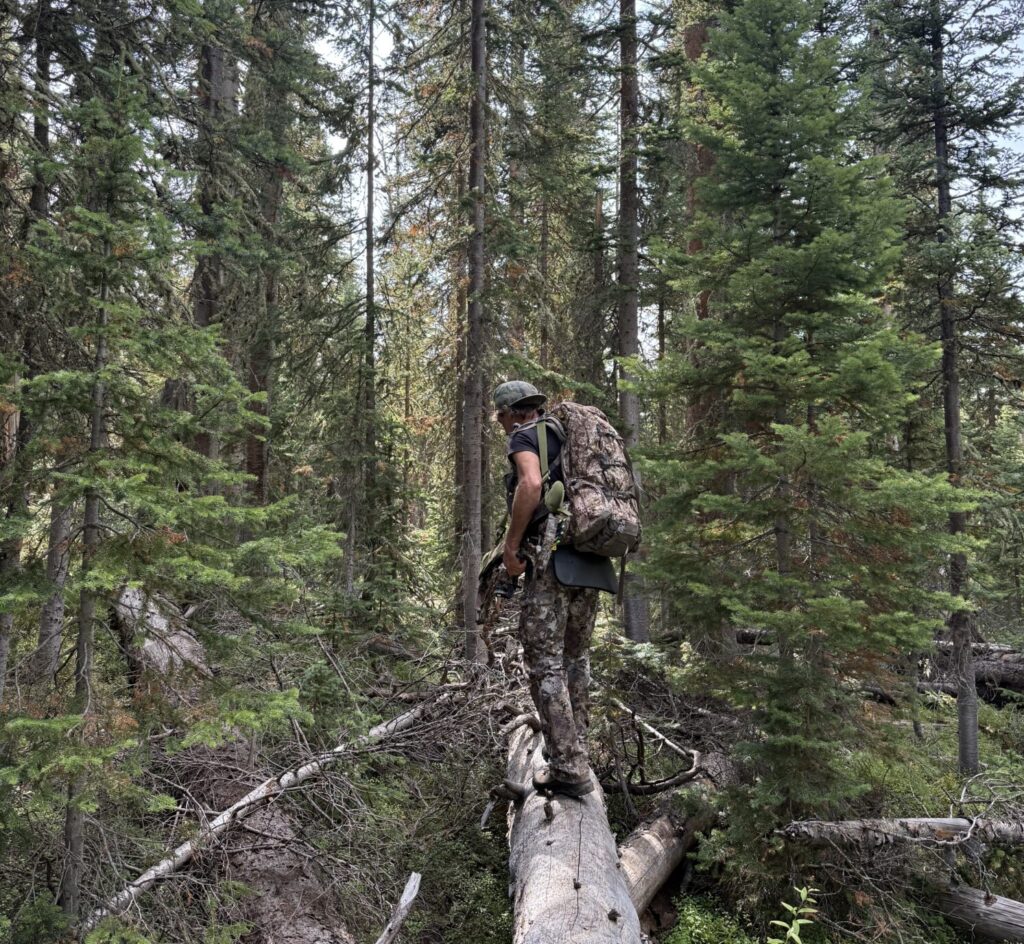
I remember hiking into the woods with my dad, staying on the curve of the mountain above the river below. In a meadow, we stop and call and sit for a short while, and move on to a bigger meadow. I remember sitting up from a short nap and beginning to plan, determining where to set up the cow moose decoy, and where my dad will have shooting lanes.
Then I hear it—grunts.
We’re on a sloped valley looking down into the meadow. The far edge is about seventy/eighty yards. The river is beyond the meadow about thirty yards. Across the river, we can see from our maps that the opposite slope rises steeply a short while and then opens into an even larger meadow. I heard the grunts—about five in a row—from about 2 o’clock. But faint, like maybe the bull is in the meadow across the river. Dad didn’t hear them, but I sit on pins and needles. After another minute. “There!” I count them out with my fingers as I hear the grunts.
The third time about three minutes later, Dad hears them too. There’s no time to set up the cow moose decoy. He takes his bow in hand and rises. The branches are so thick it’s like a screen.
He makes it only five or six steps, before I hiss. “Dad!”
I lift two fingers to my eyes and then point outward. I see it.
Through a small opening in the thicket before me, I see a long black leg and front shoulder. Above that, I see part of a flickering ear and an antler. The left antler.
I don’t have binoculars, but I swear even at seventy yards I can see this bull’s branched brow tine at the front of his antler. I hiss that to my dad as it’s what he’s been looking for the whole season. He can’t see the moose from his position, but he knocks an arrow.
The bull comes into the meadow, grunting. I see only tiny bits and pieces of him through the thicket, and what I can see is blurred by pine needles and twigs. The curve of his rump. The stilts of his legs. I’m trying to film with my phone, but also hold the whiskey bottle in case I need to get him to stop. The call is next to my knee. My heart is beating as fast as it ever has and I don’t think I’m even breathing. I’m trying to be as still as possible so as not to make a single noise, but I’m trembling. My breath, when it comes, feels like the loudest thing I’ve ever heard.
The moose, which had been walking toward me, turns to take an easier path up the steepening hill. He goes right, the side my dad is on.
The bull is broadside at thirty yards. Through a small window in the brush, I see his head for half a second. The right antler is visible.
And there’s no branched brow tine.
In fact, his antler looks strangely small.
I swear my heart stops and I question everything my eyes have ever seen. Did I imagine the bull’s branched tines?
The moose walks on. I don’t know what to do. I’m waving my hands at my dad, slashing my hand across my throat. I’m even whisper-yelling despite the moose being so close. “I don’t think it has branched brow tines. Dad, can you see? I don’t think it has branched brow tines!”
And my dad releases the arrow.
He hits the moose, because it jumps and turns, running back the way it came. I grunt, but it’s a horrible, strangled imitation because I have no air in my lungs. The bull halts on the edge of the meadow right beside where he entered. I call again.
He leaves at a walk.
I’m shaking for an entirely different reason now. Did I just tell my dad to shoot a moose without branched brow tines?
Dad comes to me, and we sink to the ground. I see his face. It’s agonized. “I think I screwed up the shot,” he says. “He’d stopped walking. He was perfectly quartered away from me. Just as I shot, his leg lifted and blocked the vitals. I think I hit his hindquarter.”
I share my worries. “I think he’s small, Dad. I don’t think he has branched brow tines.”
“Maddie.” Dad takes my shoulder. “It doesn’t matter. I shot a moose!”
Because the shot might not have been clean, we settle down to wait. We don’t want to go after it while it’s injured and scare it. My dad, who doesn’t usually snack, dumps out all the granola bars in his bag. I add mine to the pile. We each open one and start. “Call occasionally,” he says. “Keep it in the area.”
I cow moose call. A minute later, I hear a grunt. Then a second. “Maybe it’s coming back?” Moose are curious creatures. He might come back to check things out.
I call again, but don’t hear anything. We eat the entire pile of granola bars.
I know what I saw. I know what I hope for.
Then it’s time.
The game has changed.
We pack up our things and walk into the meadow looking for where the animal stood when my dad shot. We’re looking for blood.
My dad is red-green color-blind, so really, I am looking for blood.
The meadow is actually a marsh. The ground is spongy as I walk on it, which makes it easy to see the moose’s hoof prints. We see where he spun when my dad shot and the dark, ripped up patches of grass and moss where he ran. The prints are deep and larger than my foot. We can see the wide split hooves and the double indents of his dew claws at the back.
We follow the moose’s prints to the edge of the meadow, my dad standing by the last one we found while I range out searching for the next. The ground hardens, making it difficult to find the tracks. Slowly, we find prints leading into the woods and toward the river, but they’re faint. We search for a while and finally I cross the river on steppingstones. There’s a dirt game trail opposite the river that is super steep. The moment I cross the creek, I see it.
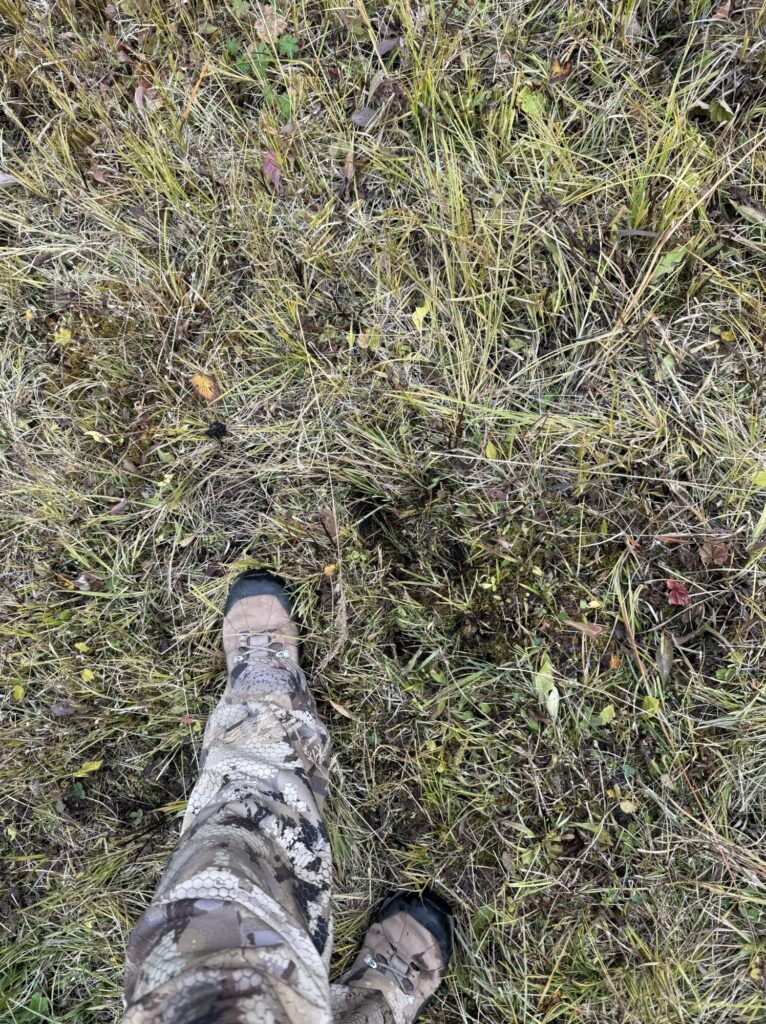
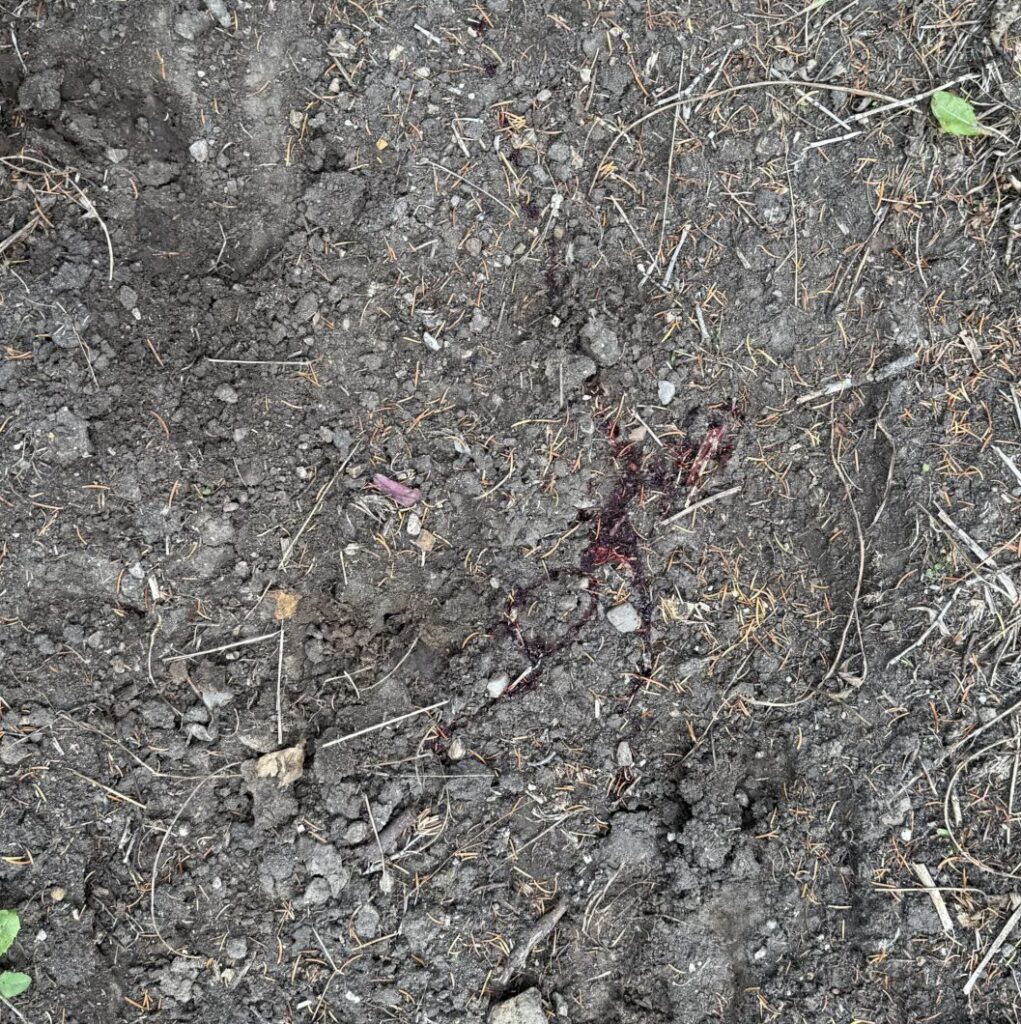
Blood. A large splatter before the ground rises and then more drips leading up the track. I yell for my dad, and he follows, standing by the large splatter. I continue up the game trail. Another splatter. Another. Then they stop. I follow the track the final ten feet up to a flat bench looking for more blood when I freeze. There.
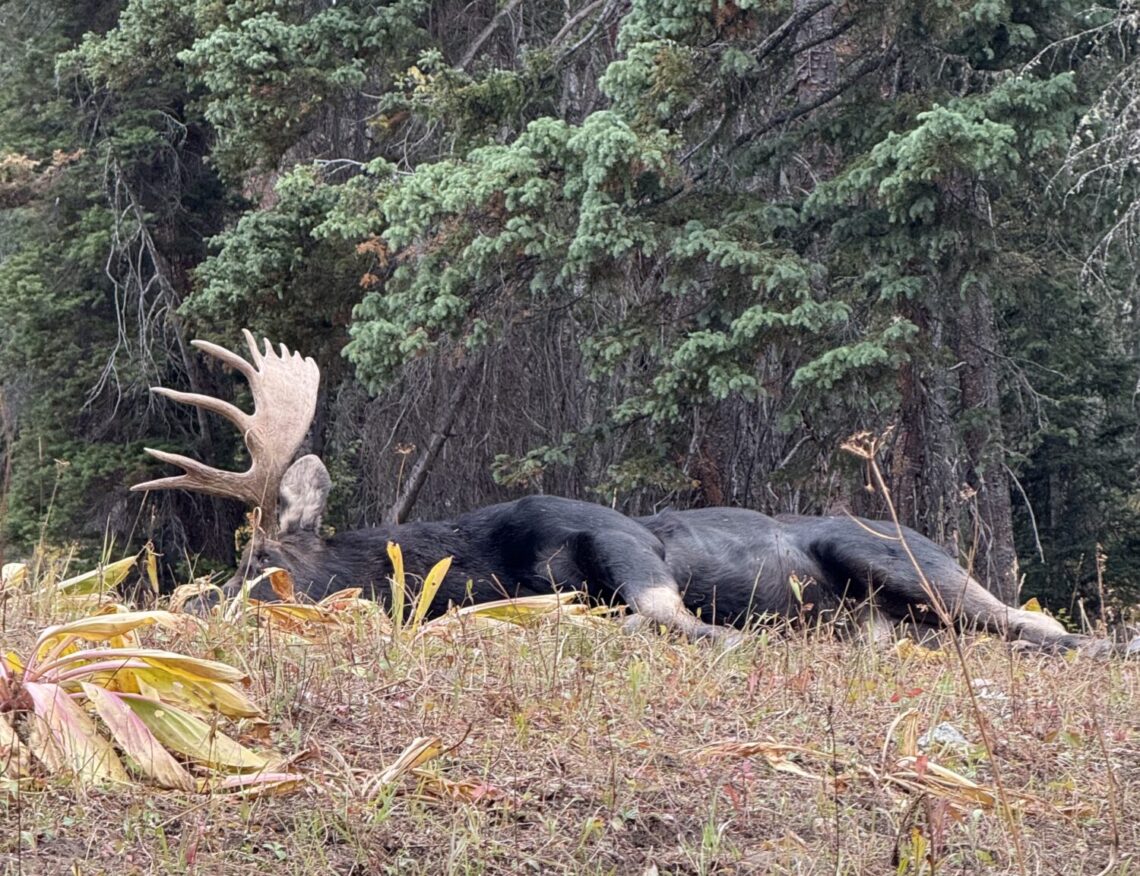
Black. Antler. Moose.
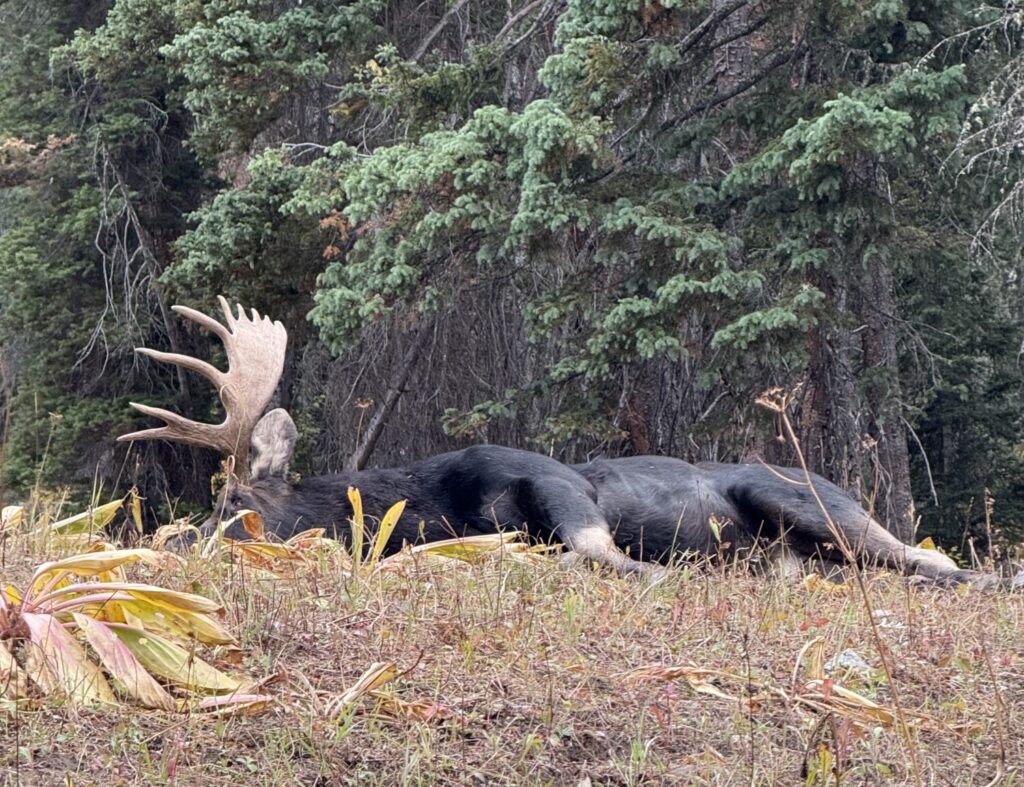
It’s lying on its side, legs outstretched. Its head is facing me so I know if it were alive, it would have easily seen me. I drop back down the slope to my dad, a grin splitting my cheeks. “Moose,” I say. “Right there.” From here, I can see the tip of its antler, but without knowing what it is, it blends into the thick grasses and thistles.
“And you know what?”
He’s smiling. “What?”
I punch his arm. “It has a branched brow tine.”
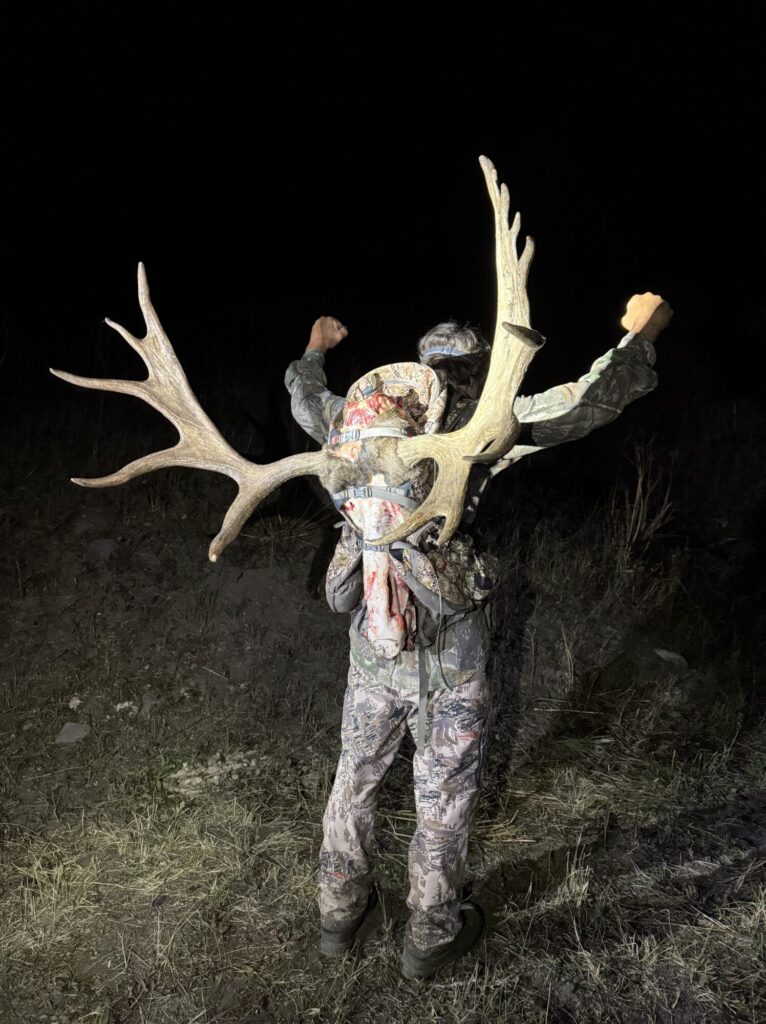
The moose’s left antler is a proper moose paddle with nine points. The right is a strange mash-up of a moose and an elk. It has five points, very little webbing between the points, and no branched brow tine.
But my dad always has to be unique, so I think it’s the perfect moose for him.
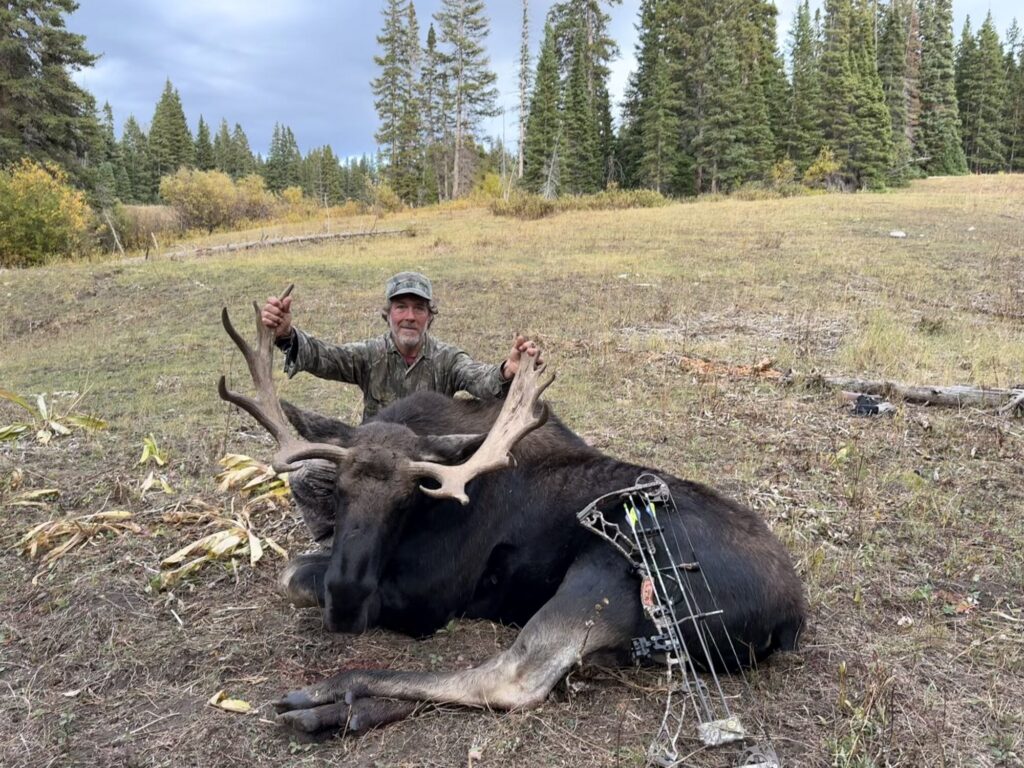
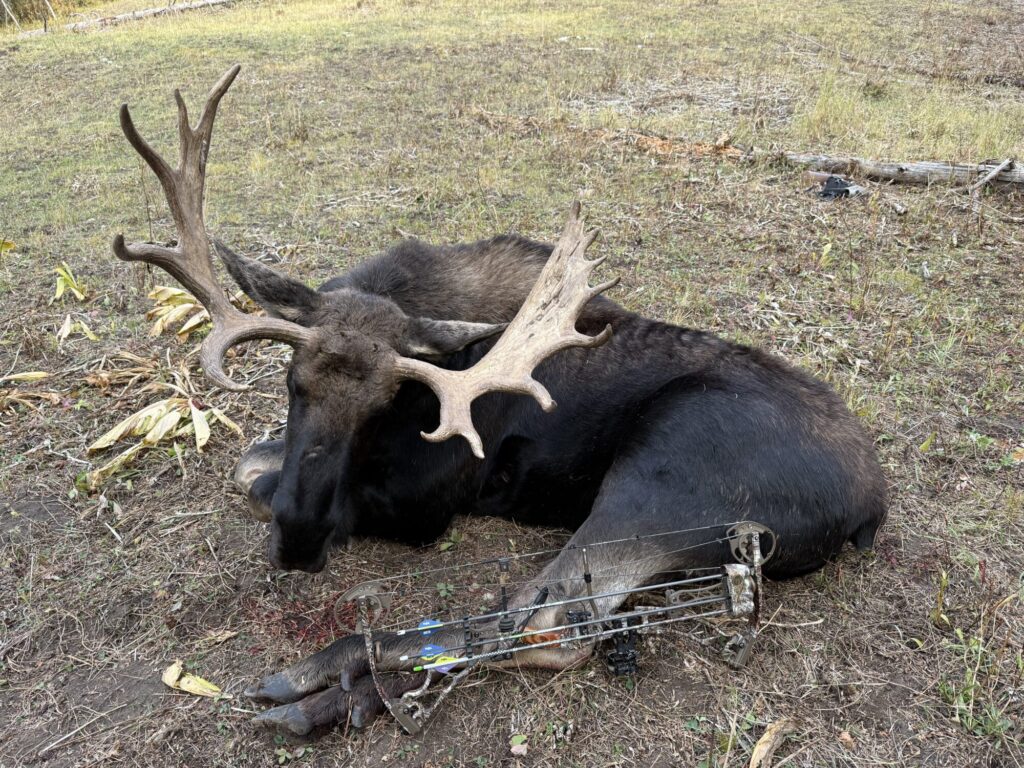
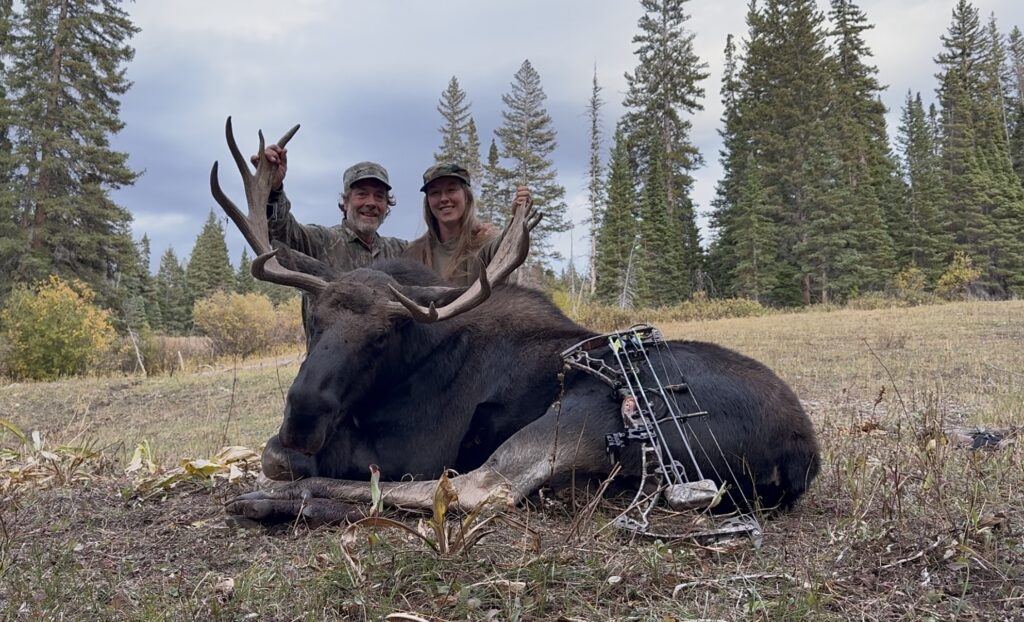
When we cut open the moose, we find the arrow did go through the hindquarter as my dad suspected, and yet it also sliced through all that thick muscle to hit both lungs and through the front shoulder. A perfect shot.
Later, Eli joins us when the elk is mostly in pieces. Taking turns, we hold the backpacks while the victim slips the straps on. I don’t know how heavy the packs really are, but as we start up the hill, I feel the chest strap digging into my ribs hard enough to bruise and I can’t take a full breath, the straps constricting my lungs.
We climb the hill. It is steep, but it is an open meadow rather than forest and deadfall. Nearing the top, we see a floating light. “Curvey!” we call. He hollers back. As we dump the first load onto the forest service road, we fall on Curve’s snacks like beasts.
We go back for a second trip, hauling the rest of the meat and the skull up to the forest service road where we left the first load.
This time when we reach the forest service road, we keep right on going, stumbling along the route for a mile. It’s easy walking, which is great because I’ve never carried anything so heavy. The straps are padded, but they still ache, digging into my shoulders and cutting off the blood to my arms.
We drop the meat into coolers and head back for the remainder.
It’s almost easy, carrying the weight of the moose. All our hope these past weeks was a much heavier burden.
But we’re hunters. We can carry heavy things.

One Comment
Don VerMeer
Maddie, I loved your post. You are an amazing writer. I felt like I was part of the hunt without all the hard work and messy buthering!!!!!